






Most healthcare providers think the biggest threats to patient care happen in food and care deserts, hospitals, clinics, or exam rooms.
But sometimes they happen in policy documents, at the federal level, on the senate room floor and house of representatives discussion.
Right now, there’s a proposed Department of Education rule that could limit federal student loan access for Physician Associate (formerly Physician Assistant) students — and most clinicians haven’t heard about it yet.
That’s why we need to talk about it.
Because you are the one this affects.
You’re the Hero of This Story
You’re the provider.
You’re the one showing up for patients every day.
You’re the one holding the system together when it’s stretched thin.
And you already know something important:
We don’t have enough clinicians.
You see it in:
- longer wait times
- staffing shortages
- burnout
- delayed care
Now imagine that pipeline shrinking even more.
That’s what’s at stake.
A Policy That Could Restrict PA Education Access
A proposed Department of Education rule could change how certain professional degree programs qualify for federal student loans.
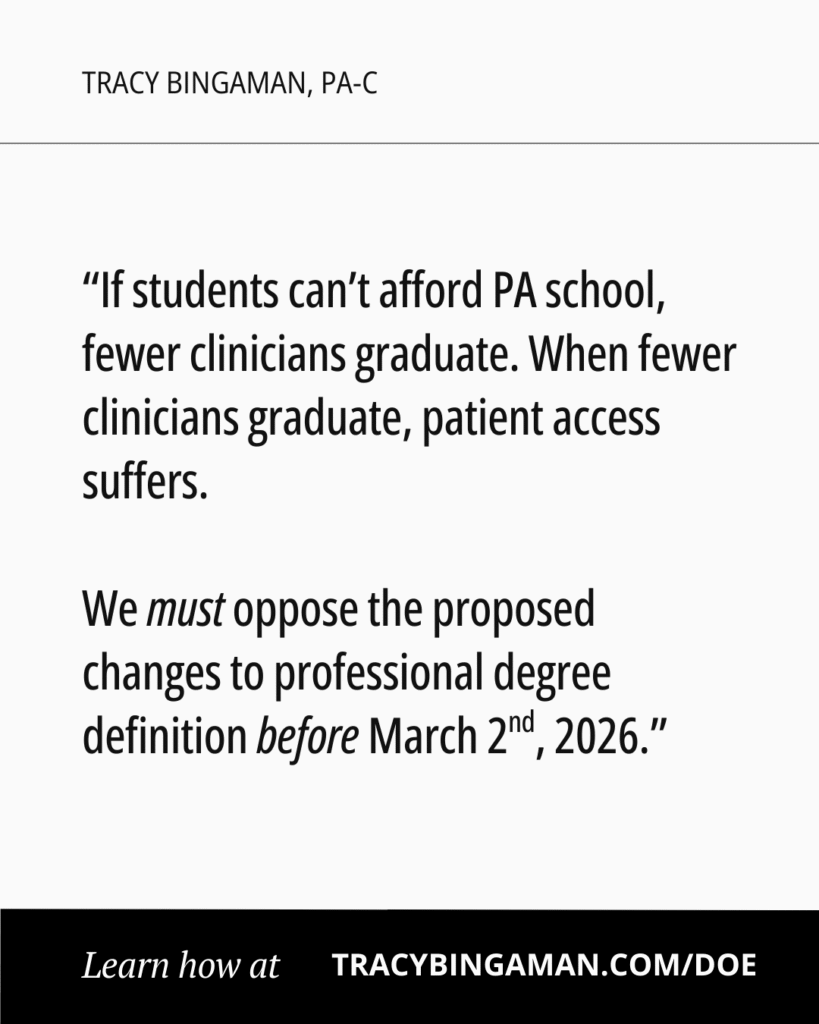
If programs like PA education lose access to federal funding pathways, many qualified students simply won’t be able to attend.
Not because they aren’t capable.
Because they can’t afford it.
Student loans aren’t optional for most PA students.
They’re how students pay for:
- tuition
- housing
- rotations
- books
- exams
- basic living expenses
No loans → fewer students → fewer graduates → fewer clinicians → less patient access.
Why This Matters & Future of Healthcare
This is about whether patients will have access to care ten years from now.
If this rule limits loan access for PA students:
- the PA workforce pipeline shrinks
- access gaps widen
- clinician burnout worsens
- patients wait longer for care
It also risks creating a system where physician training pathways remain funded while PA pathways become harder to access — widening inequities between professions that are supposed to work together.
Here’s the Good News
This is not a hopeless situation.
Policy is shaped by public input.
Comments matter.
Calls matter.
The American Academy of Physician Associates is already advocating through legislative, regulatory, and legal channels.
But professional organizations can’t do this alone.
Real change happens when clinicians speak up.
That’s where you come in. We need you to take action!
Your 3-Step Plan to Protect the PA Profession
You don’t need policy experience. You don’t need legal training. You simply need 10 minutes.
Step 1 — Read
Review the proposed rule and AAPA’s response:
https://www.aapa.org/news-central/2026/01/aapa-statement-on-department-of-educations-proposed-rule-on-federal-student-loans/
Explore the advocacy page:
https://www.aapa.org/advocacy-central/federal-student-loan-changes/
Step 2 — Comment
Submit a public comment before March 2, 2026:
https://www.federalregister.gov/documents/2026/01/30/2026-01912/reimagining-and-improving-student-education
You can literally say:
I’m a practicing PA. Limiting student loan access would restrict PA education and harm patient care. I oppose this rule & you should, too.
You could say:
I’m a practicing PA taking care of patients with diabetes in rural Montana. Limiting student loan access for Physician Associates would restrict my patient access to quality care and directly harm my vulnerable patient population. I oppose this rule and you should, too.
Step 3 — Call
Use this free tool to call your representatives: www.5Calls.org or download the App.
It provides:
- your representatives’ numbers
- scripts
- talking points
Pick up the phone. Leave ’em a message!
Why Your Voice Matters More Than You Think
Here’s something most clinicians don’t realize:
Silence gets interpreted as agreement.
Lawmakers track call volume.
They count comments.
They measure constituent engagement.
One call might feel small to you.
But thousands of small voices create policy outcomes.
The Future Is Still Writable
One of the reasons I love this profession is because we show up.
We don’t wait for problems to fix themselves.
We run toward them.
Advocacy is just another form of patient care.
It’s upstream medicine.
It’s prevention.
It’s stewardship.
And right now, the future of PA education — and patient access — needs you.
Call to Action
Read.
Comment.
Call.
Protecting PA education today protects patient care tomorrow.
If this matters to you, share this article with one colleague.
Because informed clinicians protect the future — but only if they act.
Pin for Later: